Cosmetics Manufacturing Technology in Korea: What Automation, Testing, and AI Offer Your Brand
Maria Lakienko, CEO of QTB Korea
Discussions of Korean cosmetics often focus on new actives, unusual textures, and convenient formats. For a brand commissioning production, every innovation raises practical questions: can it be manufactured, in what packaging, in what quantity, and with what result?
In my work, I assess technologies by how they help a project: speeding up preparation, supporting repeatable production, and allowing decisions to be tested before manufacturing. This is the side of innovation worth discussing when you plan to launch your own brand.
New Formulas Are Arriving Faster, Making Careful Selection More Important
In my experience, the pace of new product development has increased noticeably in recent years. Korean laboratories continually offer brands new solutions. Development can also begin from the other direction: a brand identifies a customer need and brings that brief to a manufacturer.
This gives clients more choice. They can explore different formula bases, textures, and application methods, select a suitable option from existing developments, or create a custom product.
Yet a wide selection does not make the decision for you. You need to understand why a particular property matters to your customer and how it relates to price, packaging, and product use.
That is why I consider manufacturing capabilities alongside the brand concept. A promising laboratory development needs to fit the market, budget, and purpose of the product.
Automation Supports Larger Production Volumes
At one of the manufacturers we work with, I shared the launch of new lines for stick-format sachets. Equipment of this kind makes it possible to fulfill large orders.
But a fast production line does not automatically make a small run inexpensive. The equipment still needs to be prepared and set up, then cleaned after production. These operations remain part of the manufacturing process.
A brand needs to establish whether the selected line suits its format and order quantity. A factory may have substantial capacity, but the terms of an individual project still need to be calculated separately.
I would discuss the following questions with the manufacturer:
Have you produced a similar product in the chosen format?
What order quantity is suitable for this line?
What packaging and filling constraints apply?
What will be required for a repeat production run?
These answers are more useful than a general promise of “modern equipment”: they show how the factory's capabilities will work for your specific project.
Testing Helps Assess the Formula and Packaging Together
Some technical work is invisible to the client looking at a finished jar. It consists of checks performed before a batch is manufactured.
In one of our SPF projects, we used packaging already familiar from other products. Nevertheless, the supplier requested the formula for compatibility testing, while the manufacturer scheduled stability testing in parallel. Approximately three weeks were allocated to this stage.
That timeline applied to the particular project. The testing plan and duration need to be clarified for each product.
For a business owner, the underlying approach matters: familiar packaging still needs to be checked with a new formula. And a pleasant sample texture does not resolve every question involved in preparing for production.
Testing stages should be included in the schedule from the outset, with a clear understanding of which decisions depend on their results.
AI Speeds Up Preparation and the Discussion of Ideas
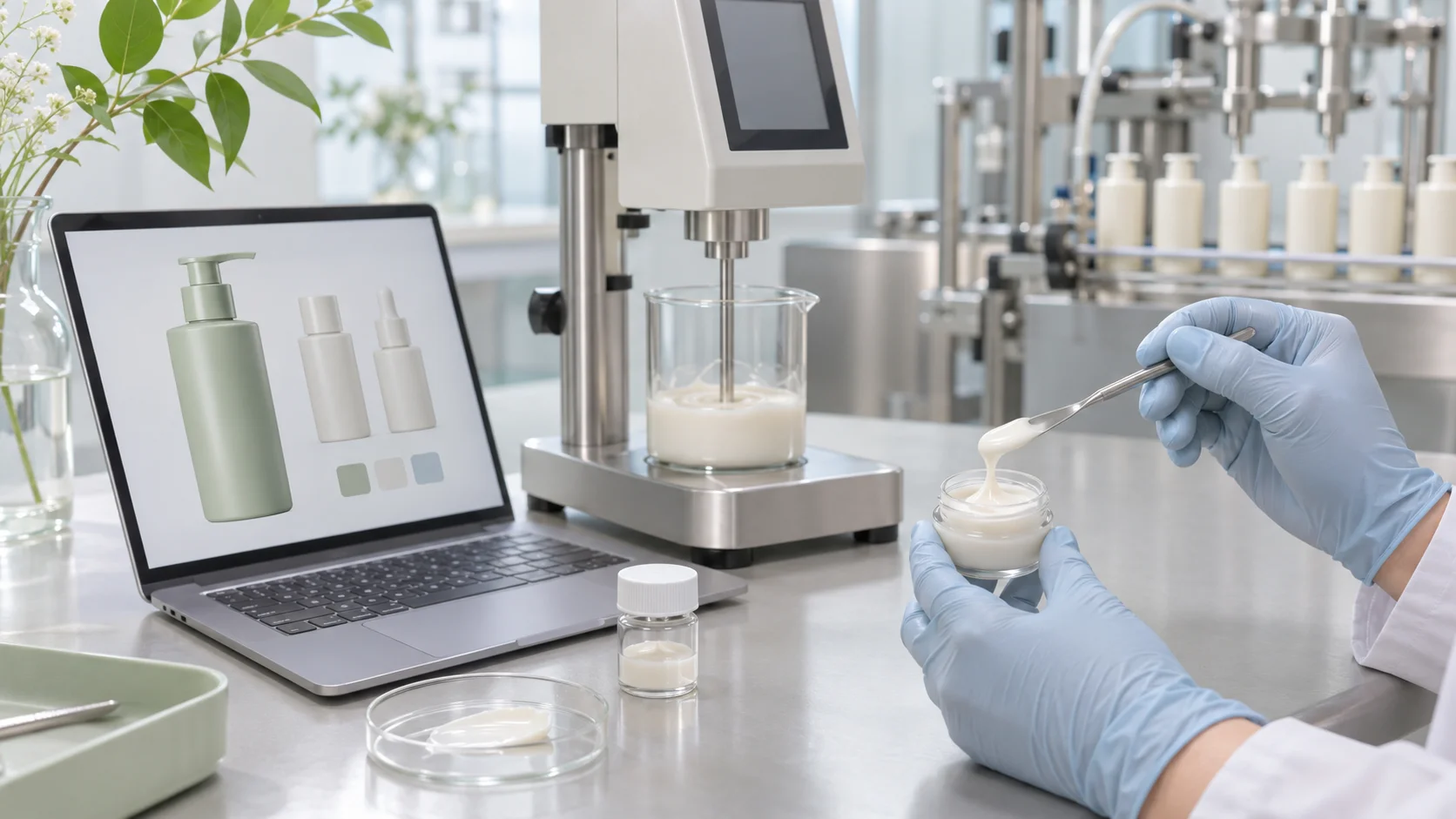
AI can help with information, exploring options, and visualization. For example, we can show a client a possible packaging concept more quickly and discuss the design direction.
A visual helps clarify preferences. But the next step is to check whether a suitable bottle exists, whether it can be manufactured, what minimum order is required, and how much the decoration will cost.
The same applies to a formula description. A product concept can be put together quickly on a screen, but texture, fragrance, and feel during use must be assessed on a physical sample.
In one SPF project, our task was to change the formula while retaining a lightweight, non-sticky texture. That required laboratory work, samples, and feedback. A convincing description alone was not enough.
Why a Quick Concept Does Not Necessarily Mean a Quick Launch
I approach promises of creating a ready-to-launch cosmetics brand in minutes with caution. An idea, name, or image can indeed be prepared quickly. Approvals, samples, adjustments, testing, packaging, and manufacturing still follow.
Digital tools help at individual stages. To shorten the overall project timeline, you need to understand exactly which stage they accelerate and what needs to happen afterward.
For example, quickly approving a visual is useful if the packaging supplier's capabilities have been checked at the same time. Otherwise, after approving the image, the project may return to searching for an available solution.
What to Ask About Technology Before Choosing a Manufacturer
When discussing a project, I recommend clarifying:
Which solutions are already established in production, and which require development?
Which samples need to be evaluated before the order is confirmed?
What formula and packaging checks are planned?
What is included in the stated preparation and production timeline?
How will approved specifications be recorded for repeat orders?
To me, technology proves its value in a product that can be manufactured, tested, and produced again with the agreed properties. Demand for that product also depends on the brand's work: understanding the customer, positioning, and sales.
Planning to develop cosmetics in Korea? At QTB Korea, we help assess manufacturing options for your concept, select formulas and packaging, coordinate sample development and evaluation, and agree on the next project stages. For an initial discussion, prepare a product description, your target audience, and your intended market.